
How Artificial Intelligence of Things (AIoT) works and its applications in practice
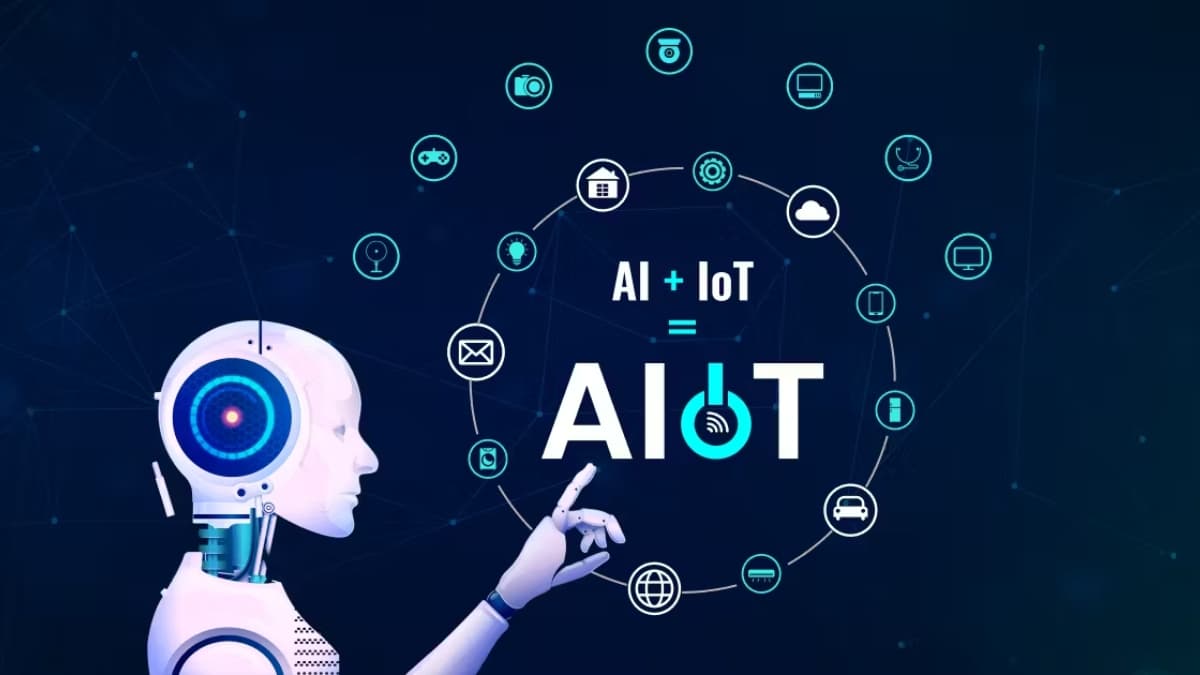
Continuing with the series of introductions to artificial intelligence knowledge, today we will learn together about a versatile tool just like its name. Look no further than AIoT - Artificial Intelligence of Things

What is Artificial Intelligence of Things (AIoT)?
Artificial Intelligence of Things (AIoT) is simply the combination of AI technology and IoT infrastructure with the goal of delivering more efficient IoT operations. This will contribute to improving data management and analysis capabilities as well as the interaction between users and applications.
In particular, IoT is a system of connected devices or any object with a unique identifier capable of transmitting data over the Internet. But the special thing is that they do not need interaction between people and computers or between people. For example, it is an implantable device that monitors heart rate, cars have built-in sensors to alert the driver when problems arise, they are assigned IP addresses and transmit data over the network. And when IoT is combined with AI, what will happen? Let's find out more together.

How does AIoT work?
In AIoT devices, AI is incorporated into infrastructure components connected by IoT networks. When operating, IoT devices will collect and process data in the initial stages. AI will then help customers analyze the collected data to provide detailed information and suggest solutions to improve work efficiency and productivity.
Basically, the operation of the AIoT system is established based on cloud-based (cloud platform) or edge-based (edge platform):
Cloud-based AIoT
Simply put, it is the management and processing of data using the cloud computing platform. Connecting IoT devices to the cloud platform is considered essential because the cloud platform is where data can be stored, processed, accessed and searched by many applications for many other services. together.
Cloud-based AIoT consists of the following four layers:
- Device layer: Some types of hardware such as cards, beacons, sensors or embedded devices, production equipment, health equipment,... (Depending on each field of activity, there will be different devices.)
- Connectivity layer: Includes cloud gateways and fields such as hardware or software that have linked cloud storage to controllers, sensors, and other smart devices.
- Cloud layer: Includes saving and processing data through AI or accessing, analyzing and visualizing data through APIs.
- User communication layer: Includes information portals from websites and mobile applications.
Edge-based AIoT
In addition to the cloud platform, AIoT data can also be processed at the edge (edge-based). Simply put, data processing delays can be minimized during analysis by having data processed as close to IoT devices as possible. They are based on three layers as follows:
- Acquisition terminal layer: Includes hardware devices such as embedded devices, production devices, tags, beacons, sensors, mobile devices, etc. Through existing power lines, they will be connected to the port.
- Connection layer: for example, the field ports that the terminal layer collects are connected via existing power lines.
- Boundary layer. These are utilities that store, process data and create detailed information from those original data sources.

Application of AIoT in practice
- Smart city: applying technology to life in residential areas. Such as sensors, lights or meters,... all combine data collection functions to analyze and propose solutions to help improve and enhance the quality of life for city residents. there.
- Smart retail: using smart cameras to recognize customers' faces when shopping or control the product scanning process at self-checkout counters is also applied by retailers to improve sales quality as well as such as controlling to avoid loss, loss,...
- Social media and human resources (HR): Many HR professionals have now begun to apply AIoT tools to their work process. Because they can integrate with media or HR-related platforms to create decision-making functions by artificial intelligence. It can be said that this is one of the most effective services for HR professionals.
- Self-driving cars: These self-driving cars rely on sensor systems and video cameras to collect data about the road, vehicles moving on the road or monitor driving status,... which are also gradually becoming familiar. belongs to today's life, right?
- Automatic delivery robots: Not only smart tasks for life or in the business environment, but for the transportation industry, AIoT is also a useful invention. Sensors that help collect data about the environment, warehouses, routes, etc. to perform automatic delivery operations accurately and quickly have also helped the transportation industry optimize a lot of costs.